Premex Power Systems Enterprise Platform
A production-ready enterprise platform that unified warranty management, inventory tracking, dealer operations, technician workflows, and content management into one scalable application.
Designed and developed a full-stack enterprise platform for Premex Power Systems featuring inventory management, QR-based warranty registration, dealer portals, technician dashboards, and a custom CMS.
A production-ready enterprise platform that unified warranty management, inventory tracking, dealer operations, technician workflows, and content management into one scalable application.
Building a scalable inventory lifecycle
Managing serialized product tracking
Supporting legacy warranty registrations
Role-based authentication
Generating QR labels dynamically
Real-time dealer workflows
Managing thousands of inventory units
Building a reusable CMS
Implemented ProductUnit lifecycle architecture
Created dual warranty engine
Developed custom RBAC
Built dynamic CMS
Integrated ImageKit
Implemented QR label generation
Optimized database indexing
Built reusable admin components
Deliverables: Corporate Website, Custom CMS, Dealer Portal, Technician Portal, Admin Dashboard, Warranty System, QR Label Generator, Blog, Analytics, PDF Generator, Authentication, Role Management.
Team: Full Stack Developer, UI Development, Backend Development, System Architecture.
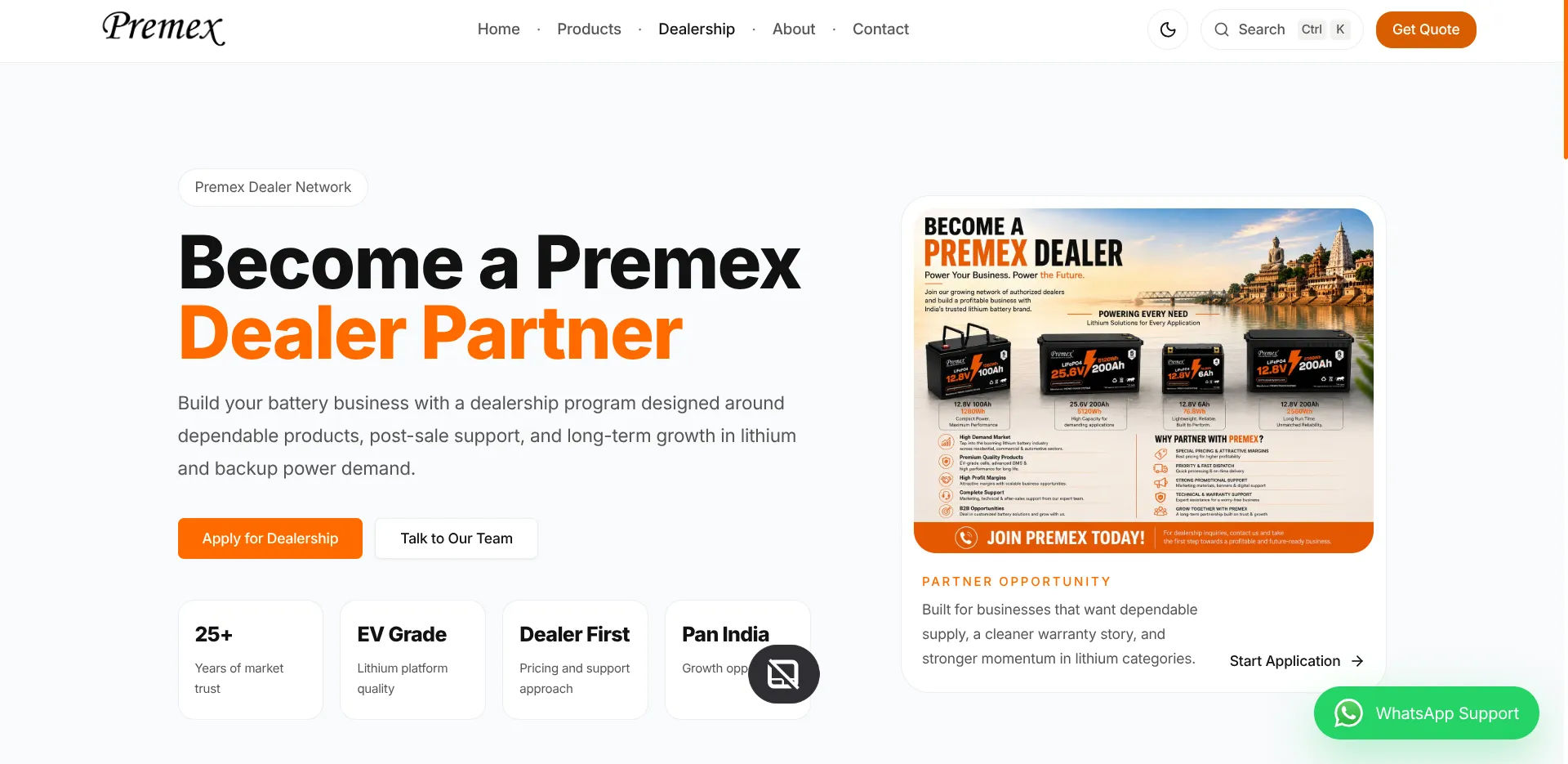
Designed and developed a full-stack enterprise platform for Premex Power Systems featuring inventory management, QR-based warranty registration, dealer portals, technician dashboards, and a custom CMS.Premex Power Systems(Kunal Kishore) field note
Reduced manual warranty processing
Building an Enterprise Warranty & Inventory Management Platform for Premex Power Systems#
Overview#
Premex Power Systems needed more than a traditional corporate website. The business required a centralized enterprise platform capable of managing product inventory, warranty registrations, dealer operations, technician workflows, customer support, and content management from a single system.
The objective was to replace multiple disconnected processes with one scalable application that could automate business operations, improve efficiency, and provide complete visibility across every stage of the product lifecycle.
To achieve this, I designed and developed a production-ready full-stack platform using Next.js, React, TypeScript, MongoDB, and modern web technologies. The platform combines a high-performance marketing website with secure role-based dashboards, an enterprise CMS, an inventory management system, a QR-based warranty engine, PDF certificate generation, and advanced administrative tools.
The result is a unified digital ecosystem that simplifies daily operations while providing an exceptional experience for customers, dealers, technicians, and administrators.
The Challenge#
Before development, several business processes relied on manual coordination between departments. Product inventory, warranty registrations, customer support, and dealer operations were handled independently, making it difficult to maintain accurate records and monitor product movement throughout its lifecycle.
The major challenges included:
• Tracking thousands of serialized products from manufacturing to customer delivery.
• Managing separate workflows for administrators, dealers, technicians, and customers.
• Supporting both modern QR-based warranty registration and legacy barcode-based products.
• Eliminating repetitive administrative work.
• Providing real-time visibility into inventory and warranty status.
• Creating printable QR labels and warranty certificates automatically.
• Allowing administrators to manage website content without requiring developer assistance.
Rather than solving these problems independently, the entire platform was engineered as one connected system where every module shares the same database, authentication system, and business logic.
Project Goals#
The primary goals of the project were:
• Develop a modern, responsive, and SEO-optimized corporate website.
• Build a scalable enterprise architecture capable of handling future business growth.
• Create a centralized content management system for non-technical administrators.
• Develop secure dashboards for administrators, dealers, and technicians.
• Automate inventory management through serialized product tracking.
• Simplify warranty registration using QR codes and legacy barcode support.
• Generate secure PDF warranty certificates automatically.
• Improve customer support through structured claim management.
• Reduce manual processes through workflow automation.
• Deliver excellent performance across desktop, tablet, and mobile devices.
Solution#
Instead of building separate applications for each department, the solution was designed as a unified enterprise platform where every business function works together seamlessly.
The platform includes:
Corporate Marketing Website
Enterprise Content Management System
Inventory Management Platform
Dealer Portal
Technician Dashboard
Admin Dashboard
Warranty Registration System
QR Label Generation
PDF Certificate Generator
Analytics Dashboard
Authentication & Role Management
Every module communicates through reusable APIs, ensuring data consistency while reducing maintenance complexity.
Technology Stack#
The platform was developed using a modern production-ready technology stack.
Frontend
Next.js (App Router)
React
TypeScript
Tailwind CSS
GSAP
Radix UI
Backend
Node.js
Next.js API Routes
MongoDB
Mongoose
Authentication
Better Auth
Role-Based Access Control (RBAC)
Infrastructure
ImageKit
Nodemailer
QRCode
pdf-lib
This stack provides excellent performance, scalability, security, and long-term maintainability while supporting modern development practices.
Public Website#
The public-facing website serves as the company's primary digital presence and has been optimized for both user experience and search engine visibility.
Key features include:
Responsive design
Dynamic product pages
Services showcase
Corporate blog
Contact forms
Dealership enquiry forms
Dynamic metadata
Open Graph integration
XML Sitemap
Robots.txt
Structured Schema Markup
Image optimization
Fast loading pages
SEO-friendly URLs
These optimizations help improve discoverability while providing a smooth browsing experience across all devices.
Enterprise Content Management System#
A custom-built CMS allows administrators to manage the entire website without modifying code.
Administrators can manage:
Products
Services
Blogs
Testimonials
Case Studies
Homepage Content
Site Settings
Media Library
SEO Metadata
Theme Configuration
This significantly reduces dependency on developers for day-to-day content updates.
Inventory Management System#
One of the most important parts of the project was the inventory management engine.
Instead of tracking only stock quantities, every physical product receives its own unique identity within the database.
Each product follows a structured lifecycle:
IN STOCK
↓
SOLD
↓
REGISTERED
↓
CLAIMED
↓
REPAIRED
↓
REPLACED
↓
EXPIRED
This architecture provides complete traceability for every individual product throughout its lifecycle.
Dual Warranty Management System#
The platform supports two different warranty registration methods.
The first uses serialized QR codes linked directly to inventory records, allowing products to be verified instantly.
The second supports legacy products through barcode-based registration, ensuring backward compatibility for existing customers.
When a warranty is successfully registered, the system automatically generates a downloadable PDF warranty certificate containing product details, registration information, verification data, and a secure QR code.
Dealer Portal#
Authorized dealers receive access to a dedicated dashboard where they can manage assigned inventory efficiently.
Features include:
Inventory lookup
Sales registration
Product allocation
Warranty tracking
Inventory status updates
CSV exports
Dashboard analytics
Dealer profile management
The portal simplifies daily dealer operations while ensuring accurate inventory records.
Technician Dashboard#
Technicians use a dedicated workspace to manage warranty claims and repair requests.
The workflow follows structured claim stages:
Submitted
Reviewing
Approved
Repairing
Completed
Rejected
Every status update is recorded automatically, providing a complete audit trail for future reference.
Administration Dashboard#
The administration dashboard serves as the central control panel for the entire platform.
Administrators can manage:
Users
Products
Inventory
Warranty Registrations
Dealers
Technicians
Claims
Content
Website Settings
Media
Reports
Notifications
System Configuration
This provides complete operational visibility through a single interface.
Performance & Optimization#
Performance was a major consideration throughout development.
The platform includes:
Server-side rendering
Dynamic routing
Image optimization
Lazy loading
Code splitting
Metadata optimization
Structured data
Efficient database queries
Caching strategies
Responsive images
Accessibility improvements
These optimizations help deliver fast page loading speeds and excellent user experience.
Security#
Security has been integrated into every layer of the application.
Implemented measures include:
Role-Based Access Control
Secure Authentication
Password Encryption
Session Management
Input Validation
Protected API Routes
Permission-Based Dashboards
Audit Logging
Secure File Uploads
Server-Side Validation
These features help ensure business data remains secure while providing appropriate access for every user role.
Business Impact#
The completed platform transformed multiple disconnected workflows into one centralized enterprise application.
The solution helped:
Centralize business operations.
Automate inventory tracking.
Reduce manual administrative work.
Improve warranty registration accuracy.
Provide real-time operational visibility.
Enable dealer self-service.
Improve technician workflow management.
Simplify content publishing.
Increase operational efficiency.
Create a scalable foundation for future business growth.
Conclusion#
The Premex Power Systems platform demonstrates how modern full-stack development can solve complex business challenges through thoughtful software architecture.
By combining a high-performance marketing website with enterprise dashboards, inventory management, QR-based warranty registration, content management, and workflow automation, the platform provides a scalable digital ecosystem capable of supporting long-term business growth.
This project highlights expertise in enterprise software development, full-stack engineering, Next.js architecture, MongoDB database design, business automation, custom CMS development, and production-ready web application development. The architecture is designed to remain maintainable, extensible, and adaptable as business requirements continue to evolve.